
AUTHOR: Robert Kocewicz, VestaEco
As the construction industry seeks carbon-neutral solutions, paludiculture biomass (wetland crops) is emerging as a rapidly renewable alternative to traditional wood. Through the PaluWise project, our partner VestaEco is demonstrating how sedges and typha can be transformed into high-performance acoustic and insulation boards. This transition not only provides a sustainable raw material for bio-based industries but also supports peatland rewetting, climate mitigation, and biodiversity.
Can Paludiculture replace wood in sustainable construction?
Side-stream biomass from paludiculture has the potential to substitute wood as a raw material in the particleboard and fiberboard production industry. In a wider context, paludiculture as a source of biomass offers several advantages compared with wood sourced from forestry. While both streams are biogenic and renewable, paludiculture biomass belongs to the category of rapidly renewable raw materials (similar to cork, bamboo, or straw), whereas wood is renewable only in the long term.
Properly managed paludiculture plantations provide additional environmental benefits, including, first and foremost, the reduction of CO₂ emissions from previously drained peatlands. This, combined with the CO₂ stored during plant growth, results in lower embodied-carbon levels in paludiculture-based materials compared with wood-based ones (although quantitative assessments related to specific applications are still the subject of scientific investigation). Among other benefits, the sustainable management of paludiculture plantations contributes to water retention, supports biodiversity, and creates attractive landscapes, especially in peri-urban areas.
How is VestaEco using sedges and typha for acoustic insulation?
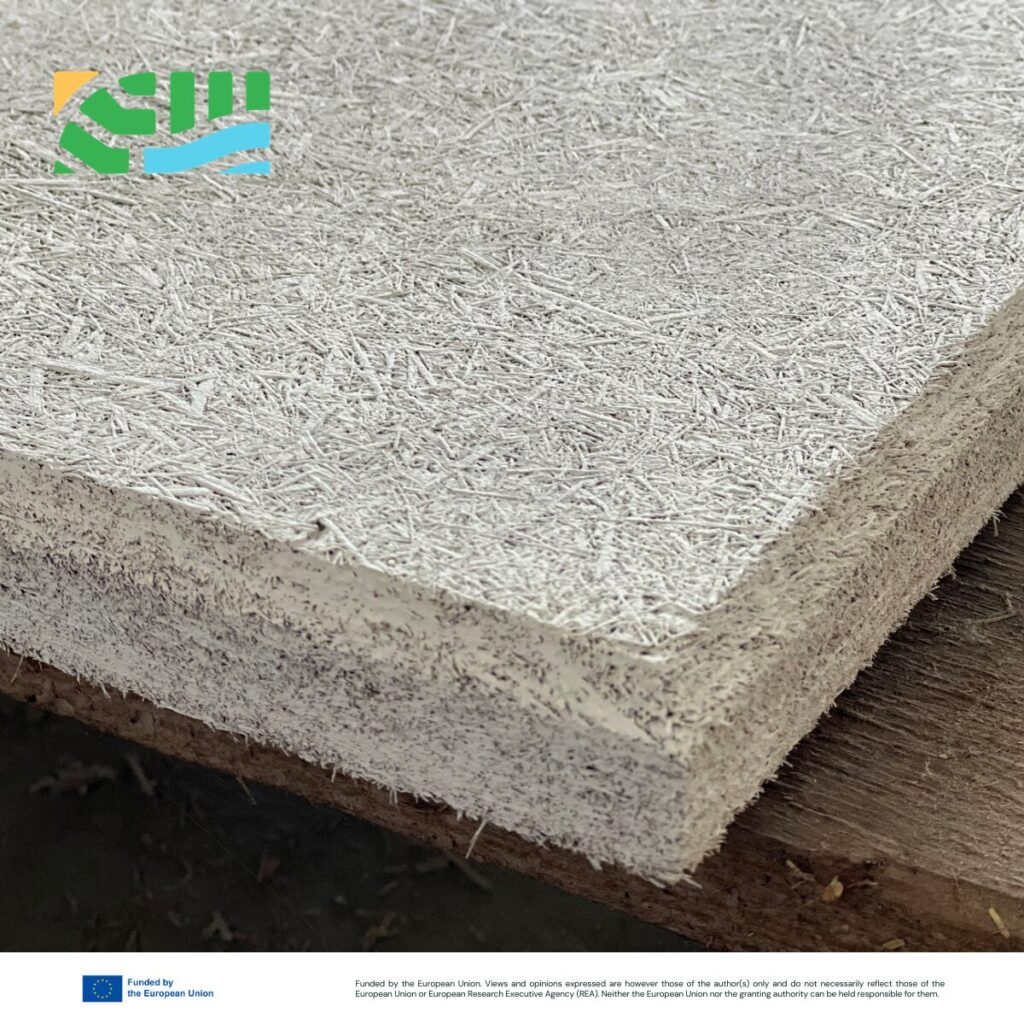
VestaEco – a Polish manufacturer of bio-based insulation panels – is an industrial partner of the PaluWise consortium responsible for demonstrating the use of paludi-biomass for the production of insulation boards. In particular, sedges and typha coming from the Polish demonstration site in Kuwasy are to be valorised as a raw material for the production of insulation boards intended for the construction industry.

Bearing in mind the current market demand for bio-based materials, a decision has been made to focus on acoustic applications of the sedge-based panels rather than thermal insulation applications. Thus, VestaEco’s dry strawboard technology has been considered as the starting point for experimental research using sedges and/or typha instead of cereal straw.

What is the process for developing wetland-based panels?
Taking into account the parameters of the acoustic insulation panels expected by the end users, two main research objectives have been established:
- (i) to determine the optimal (low to medium) board density ensuring good sound absorption performance and mechanical strength sufficient for the intended use, and
- (ii) to develop a fire protection method allowing the required reaction-to-fire class to be reached for the intended application (wall and ceiling cladding with or without a cavity).
In addition, the project objective has been to upscale and demonstrate the panel production technology at an advanced Technology Readiness Level (TRL 6).
The experimental research plan has been structured into several stages, starting with a theoretical analysis of 24 variants, then proceeding with a lab-scale development of 3 pre-selected variants, and ending with a full-scale development of the most promising variant. The initial factors considered in the experimental plan comprise: plant species, particle size, board density, and type of bonding agent.
An additional factor introduced at the lab-scale stage concerns the application technique of the flame retardant. The variant selection criteria after the first and second stages include the theoretical analysis results as well as basic mechanical and fire tests, respectively.
How is the production of paludiculture boards scaled to an industrial level?
The upscaling of the final variant to full-scale production consists of manufacturing a trial batch of 25 mm thick, 1200 × 2400 mm panels using the VestaEco hot-pressing line, including cutting into final formats, surface sanding, and coating. The process parameters established during the upscaling stage (electrical and heating energy consumption, processing times, and use of consumables), together with the results on the carbon storage capacity of the biomass itself, are crucial for calculating the carbon footprint of the final product.

Why is Paludiculture Biomass a Credible Substitute for Wood in Industry?
Paludiculture-derived biomass, such as sedges and typha, has demonstrated strong potential as a promising raw material of the future for the board production industry. The experimental results indicate that, when processed using adapted bio-based technologies, this wetland biomass can meet the mechanical, acoustic, and fire performance requirements expected from construction products. Importantly, it offers a credible pathway to substituting wood in selected board applications, while simultaneously supporting climate-positive land management and carbon storage.
Lorem Ipsum is simply dummy text of the printing and typesetting industry. Lorem Ipsum has been the industry’s standard dummy text ever since the 1500s, when an unknown printer took a galley of type and scrambled it to make a type specimen book. It has survived not only five centuries, but also the leap into electronic typesetting, remaining essentially unchanged. It was popularised in the 1960s with the release of Letraset sheets containing Lorem Ipsum passages, and more recently with desktop publishing software like Aldus PageMaker including versions of Lorem Ipsum.